




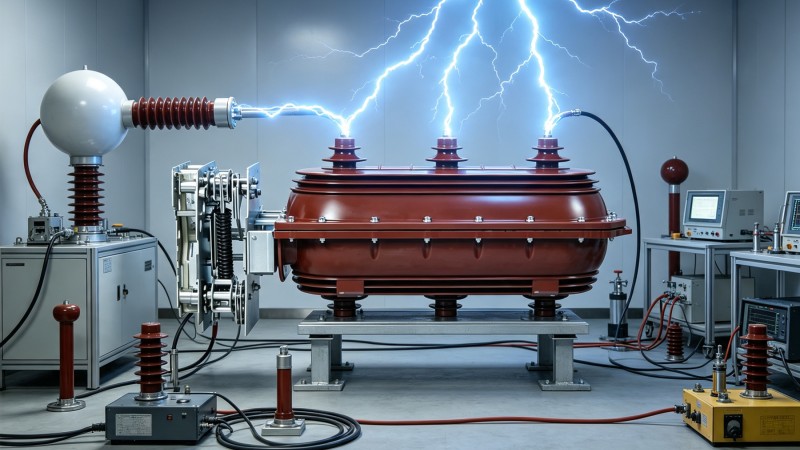
According to the IEC 62271-103 standard, 24KV 630A indoor SF6 load break switches must pass the 1.2/50μs standard lightning impulse withstand test. This is a mandatory type test for product certification and overseas power project bidding, including Indonesia PLN and Central Asian grid projects. The test simulates instantaneous overvoltage shocks caused by lightning strikes to verify the product’s insulation performance, electric field uniformity and structural reliability. Common test failures mainly include surface flashover, partial discharge and internal breakdown. Combining actual mass production problems and standard specifications, this article proposes systematic optimization solutions covering conductor processing, structural design, insulation upgrading and production process control to effectively improve the lightning impulse test pass rate of 24KV indoor SF6 load break switches.
Local electric field distortion on conductive parts is the main cause of lightning impulse breakdown. Burrs, sharp corners, surface scratches and uneven plating on internal copper bars, contacts and conductive brackets will concentrate electric field energy. Under instantaneous high impulse voltage, such defects easily trigger air ionization and SF6 partial discharge, eventually causing flashover and breakdown. The core optimization measure is to increase the silver plating thickness of internal copper components. Upgrading the conventional 3–5μm silver plating to 8–10μm completely solves hidden risks such as substrate exposure, plating pinholes and surface wear. The thickened and high-flatness silver layer optimizes surface roughness, uniformly disperses high-voltage electric fields, and avoids electric field distortion caused by long-term oxidation. In addition, all conductive parts must be precisely rounded and passivated after machining. All right angles and sharp edges are fully polished to eliminate electric field concentration points from the source.
Sufficient and standardized electrical clearance and creepage distance are the basic guarantee for passing lightning impulse tests. Most test failures occur due to insufficient insulation margin between phases, phase-to-ground gaps and opening fracture gaps. In accordance with IEC standard requirements, the product’s core insulation gaps are optimized and standardized: the minimum phase-to-phase and phase-to-ground electrical clearance is guaranteed to be ≥18mm, and the opening isolation fracture gap is increased to ≥22mm, providing sufficient overvoltage withstand margin. Meanwhile, the layout of insulating partitions and insulators is optimized to increase creepage distance. High-strength integral epoxy insulation parts are adopted to avoid structural defects such as thin walls and cracks, preventing high-voltage surface flashover. Redundant floating metal fasteners inside the SF6 gas chamber are removed to eliminate partial discharge risks caused by floating potential and stabilize the internal electric field distribution.
High-performance insulation materials and standardized SF6 gas chamber processes ensure stable impulse withstand voltage performance. Traditional low-grade insulation materials have low withstand strength and high hygroscopicity, which are prone to breakdown under lightning impulse voltage. Special high-withstand, low-dielectric-loss epoxy insulation materials that meet IEC high-voltage equipment standards are adopted to improve arc resistance and insulation stability. Strict gas chamber processing standards are implemented during production: all internal dust, metal debris and foreign impurities are thoroughly cleaned before assembly, as tiny particles will induce partial discharge and lead to test failure. The SF6 gas purity is strictly controlled above 99.99% with qualified micro-water content, preventing insulation performance attenuation caused by moisture and impurities.
Standardized assembly processes and pre-delivery testing further improve product test stability. All assembly operations are carried out in a dust-free environment to avoid residual sundries inside the gas chamber. Accurate positioning and alignment of conductive components are strictly implemented to prevent uneven gaps and electric field offset caused by component deviation. A pre-delivery partial discharge detection procedure is added to eliminate hidden insulation defects in advance. The test environment is standardized with stable temperature and humidity and shielded external electromagnetic interference to ensure accurate and reliable test data. The above comprehensive optimization measures can completely solve lightning impulse flashover and breakdown problems of 24KV indoor SF6 load break switches, ensure stable passing of 1.2/50μs full-wave lightning impulse tests, and fully meet IEC standards and overseas grid project acceptance criteria.
Leave a comment