




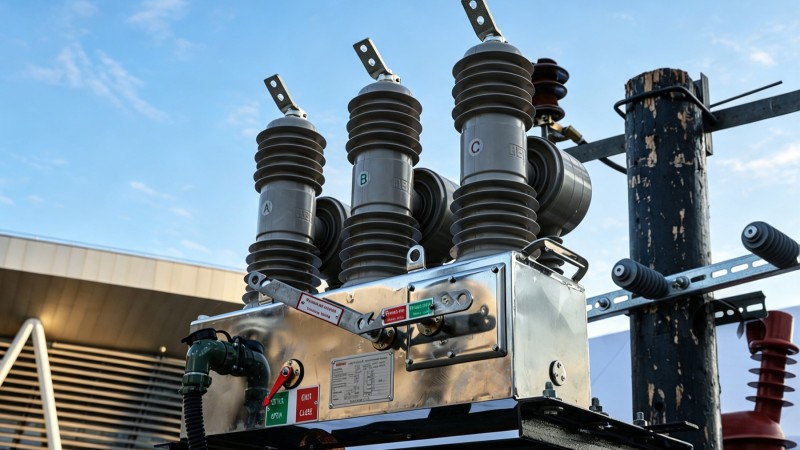
Making Test Introduction for 24kV Vacuum Circuit Breaker
Applicable Standards: GB 1984-2014 (IEC 62271-100); Rated voltage Ur=24kV. Test Purpose: To verify the capability of the circuit breaker to close onto a pre-existing short-circuit fault. The breaker shall withstand the peak short-circuit making current (rated short-circuit making current = 2.5 × peak value of rated short-circuit breaking current), electrodynamic forces and pre-strike arcing during closing. No contact welding, mechanism jamming or vacuum interrupter damage shall occur.
⚠️ Distinction: Short-circuit making test ≠ No-load mechanical closing test. The making test is closing onto a short-circuit under high voltage; mechanical closing characteristics test is performed without voltage.
I. Preconditions Before Test (Mandatory for Type Test)
1. Test Sample Status
- The circuit breaker shall be fully assembled (solid-sealed pole, spring/permanent magnet operating mechanism, interlock and anti-pumping device installed consistent with delivery status).
- The circuit breaker is in open position and the operating mechanism is fully charged.
- Pre-tests shall be completed prior to formal test: mechanical characteristics test, contact resistance measurement and power frequency withstand voltage test to confirm basic performance compliance.
- Operating power supply: The making test shall be carried out under three operating conditions respectively: maximum operating voltage (110% Uc), rated operating voltage Uc, minimum closing voltage (80% Uc).
2. Test Circuit Selection
- Direct test: High-capacity impulse generator test station (three-phase test preferred).
- Synthetic test: Adopted when laboratory capacity is insufficient (in accordance with GB/T 4473). Direct test is commonly used for 24kV circuit breakers. Circuit composition: Test power supply → Short-circuit transformer → Adjustable reactance/resistor → Tested 24kV circuit breaker → Earth. Equipped with voltage divider, current transformer and high-speed oscillograph.
3. Key Test Parameters (General for 24kV products)
- Applied voltage: ≥24kV for three-phase test (0.9~1.1Ur); For single-pole first-pole test, the first-pole factor of 1.3 times phase voltage shall be adopted.
- Peak rated short-circuit making current Ipeak
- Frequency: 50Hz
- Required test operations: 3 valid making operations (three poles tested simultaneously for three-phase circuit breaker)
- Pre-strike is permitted: Pre-strike breakdown and arcing during closing are normal phenomena recognized by standards.
II. Complete Standard Test Procedure
Stage 1: Test Preparation & Safety Verification
- Isolate the test area with fencing, warning signs and reliable earthing. All non-test metallic enclosures shall be earthed.
- Wiring verification:
- Primary circuit: Test power supply connected to short-circuit circuit and breaker incoming terminal; breaker outgoing side short-circuited and earthed to simulate short-circuit fault.
- Secondary circuit: Closing control power supply connected to breaker closing circuit; oscilloscope channels connected to signals of interrupter voltage and phase currents.
- Instrument commissioning: High-speed oscillograph (sampling rate ≥1MHz) to record interrupter voltage, phase currents and closing trigger timing.
- No-load timing pre-adjustment: Perform multiple closing operations without high voltage to verify closing timing and trigger synchronization, confirm no mechanism jamming.
Stage 2: Half-current Pre-test (Circuit Calibration, not counted as formal test operations)
- Reduce test power supply, set 50% prospective short-circuit current and rated test voltage.
- Trigger circuit breaker closing; record voltage and current waveforms.
- Verify short-circuit current amplitude, phase angle, circuit impedance and trigger delay.
- Fine-tune reactance and closing trigger phase angle to find the most onerous closing phase (near voltage peak, causing maximum pre-strike and making current).
Key point: The making test shall be performed at the most unfavourable phase angle to simulate worst site operating conditions.
Stage 3: Formal Short-circuit Making Test (Core Procedure)
Standard sequence: Tests shall be implemented respectively under maximum operating voltage, rated operating voltage and minimum closing voltage. Procedure for each operating condition:
- Restore circuit parameters to rated test voltage and rated short-circuit making current; reset breaker to open position and recharge mechanism.
- Precise synchronization by control system; send closing command at preset worst-case phase angle.
- Circuit breaker closes onto pre-existing short-circuit; oscillograph continuously captures waveforms: ✅ Pre-strike moment ✅ Peak making current and DC component ✅ Three-phase closing asynchronous time
- Maintain closing status for ≥0.1s to ensure full application of short-circuit current; perform remote opening to interrupt short-circuit current.
- Allow sufficient cooling interval for test sample (normally ≥3 minutes per manufacturer’s requirement to avoid cumulative overheating).
- Preliminary visual inspection: Check for obvious arc ejection, abnormal noise or smoke; measure contact resistance and compare with initial value before test.
- Repeat operations to complete 3 consecutive valid making operations under identical conditions.
For Type Test T100s test duty: Symmetrical short-circuit making test shall be completed independently; subsequent CO operations verify asymmetrical making capability.
Stage 4: Post-test Inspection (Key Criteria for Acceptance)
Inspection after each making operation and upon completion of all tests:
- Visual inspection:
- No damage or obvious gas leakage of vacuum interrupter;
- No severe contact welding or extensive ablation;
- No mechanism deformation, jamming or loose fasteners.
- Functional test: Perform 5 consecutive no-load closing-opening operations; smooth operation without sticking.
- Conductive loop resistance: Resistance after test shall not exceed 1.2 times initial value (limit specified by manufacturer).
- Power frequency withstand voltage test across open contacts: Retest in accordance with standard withstand voltage value for 24kV equipment; no breakdown or flashover.
- Waveform analysis based on oscillograph records:
- Making current reaches specified peak value;
- No permanent contact adhesion preventing opening;
- Pre-strike arc shall not cause permanent equipment damage.
III. Acceptance Criteria (GB 1984)
The test is deemed passed only if all requirements below are satisfied:
- All 3 making operations are successful; no contact welding and adhesion, the circuit breaker can open reliably.
- Mechanism operates normally after test without permanent mechanical damage.
- Loop resistance and insulation performance meet technical specifications.
- Forbidden phenomena: Vacuum interrupter rupture, insulation breakdown, permanent mechanism deformation.
- Permitted phenomena: Minor contact ablation and pre-strike arcing during closing.
IV. Common Test Abnormalities & Explanation
- Excessive closing bounce: Bounce superimposed with short-circuit electrodynamic force easily leads to contact welding and test failure. Closing bounce of 24kV vacuum circuit breaker is generally required ≤2ms.
- Excessively long pre-strike duration: High arc energy causes severe contact ablation. Frequent long-duration pre-strike requires inspection of vacuum interrupter and closing speed.
- Excessive DC component: Caused by improper circuit parameter setting, leading to high asymmetry of making current.
- Concept distinction:
- Making current: Closing onto short-circuit; mandatory item for type test.
- Ordinary closing test: No-load without high voltage, only for mechanical characteristics measurement, cannot replace short-circuit making test.
V. Supplementary Information: Routine Test vs Type Test
- Type Test (Third-party Laboratory): Complete short-circuit making test with high-voltage short-circuit circuit.
- Factory Routine Test: No high voltage short-circuit making test, only no-load mechanical closing test, operating voltage test and loop resistance measurement. Short-circuit making test is only performed for type test.
Leave a comment